
Hitting GDP growth of more than six per cent will require substantial foreign direct investment, especially if household savings largely continue to remain locked.

The challenges before the coming Budget are more daunting than those in 2021, reveals A K Bhattacharya.

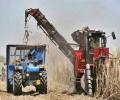
The farm sector has been resilient to the COVID-19 shock and is estimated to grow at 3.9 per cent this fiscal, the Economic Survey said on Monday, while suggesting to the government to give priority to crop diversification, allied farm sectors and alternative fertilisers like Nano urea. The Economic Survey 2021-22 also pitched for increasing agriculture research and development (R&D) and organic farming, besides use of new technologies like drones. "The performance of the agriculture and the allied sector has been resilient to the COVID-19 shock. ...Growth in allied sectors including livestock, dairying and fisheries has been the major drivers of overall growth in the sector," the Survey said. The agriculture sector has experienced buoyant growth in the past two years.

PSU divestment, LIC IPO, fiscal deficit: Budget 2021 marks a clear change in the Modi government's stance from fiscal conservatism to growth orientation.

India has not been able to compete with countries such as Bangladesh and Vietnam.

The primary and immediate impact of a depreciating rupee is on the importers who will have to shell out more for the same quantity and price. However, it is a boon for the exporters as they receive more rupees in exchange for dollars. The rupee depreciation has wiped away some of the gains that would have accrued to India from international oil and fuel prices dropping to pre-Ukraine war levels.
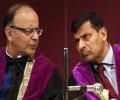
Arun Jaitley had a tough fiscal hill to climb.

Economic reforms seem to be on a slow train, while good old fiscal populism is alive and flourishing.

No government can 'ignore inclusiveness in a democracy', Montek Singh Ahluwalia tells Anjuli Bhargava.

The stellar rise in corporate earnings in financial year 2021-22 (FY21) and FY22 did not result in a corresponding boom in capital expenditure (capex), with listed companies' investment in fixed assets rising just 2.3 per cent year-on-year (YoY) in FY22, growing at the slowest pace in the last six years. In comparison, the firms' combined net profit jumped 63.5 per cent YoY in FY22, while net sales increased 31.1 per cent - the fastest pace in over a decade. The 955 non-financial companies in Business Standard's sample reported combined net profit of Rs 7.18 trillion in FY22, compared with Rs 4.39 trillion in FY21 and Rs 2.59 trillion in FY20.

Despite crude comfort, heavy spending cuts needed to offset Rs 80k-cr revenue shortfall

Politically, it will not be easy for Modi to take hard decisions such as raising fuel prices in the first budget, given the risk of higher inflation.

Indians want change and progress. They should be willing to accept tough decisions, says Sanjeev Nayyar.
With economic activity still to reach pre-pandemic levels, the RBI may slow down the pace of rate hikes until next year to quell soaring inflation while supporting growth, the Asian Development Bank (ADB) says in its latest report. The Manila-based multilateral funding agency has raised the inflation forecast for the current fiscal year ending in March 2023 to 6.7 per cent from its earlier projection of 5.8 per cent. For the next fiscal year too, the forecast has been revised upwards to 5.8 per cent from 5 per cent earlier.

'80% of the rural and urban population don't have enough purchasing power.'
Budget should raise revenues & reduce spending to increase capital expenditure.

The finance minister has stayed true to her commitment to fiscal consolidation, even though the pace of the decline in the deficit could have been faster, notes A K Bhattacharya.

Only 80.6 per cent of the Rs 6-trillion allocation has been spent by February, data from the Controller General of Accounts shows.

Markets have gone into a tailspin, the Modi govt must revive investment sentiment.

The absence of a clear underlying economic ideology in the Budget was quite evident, say experts.

An empowered group of ministers headed by Defence Minister A K Antony is to consider an Oil Ministry proposal of abolishing the priority ranking according to which natural gas is first given to urea manufacturing fertiliser plants, then to LPG units, followed by power plants, city gas, steel and refineries.

The problem lies in the fact that those in charge of telling the government's side of the story lack the three things that matter most, namely, the ability to comprehend, communication skills, and the tricks needed for good articulation, observes T C A Srinivasa-Raghavan.

Prices of natural gas, which is used to produce fertiliser and generate electricity and is also converted into CNG for use in automobiles as fuel and cooking gas for households, are set every six months -- on April 1 and October 1 each year.

There will be incentives in interest rates offered to farmers so that they can to pay back agriculture loans in time, says Finance Minister Pranab Mukherjee

'The PM cannot give a single reason why farmers should trust him.'

Slamming the Union budget as 'insipid' and lacking in stimulus for growth, the Congress on Saturday said it does not address the main issue of unemployment and describes the mindset of the government.

Evidently, households see a brighter future after the Budget, reveals Mahesh Vyas.

Budget for 2022-2023 has returned to its agenda for protectionism in the name of creating a self-reliant India, points out A K Bhattacharya.
The government will roll out its ambitious scheme of transferring cash to beneficiaries of select schemes in 20 districts on Tuesday, but food, fertiliser and fuel subsidies will not be covered in the initial phase.

Experts say the party is undoing what it achieved through MNREGA by targeting beneficiaries
Government's direct cash transfer scheme is "anti-poor" as it would actually cut subsidies due to the high inflation rate and not cover the rising prices of foodgrains, the Communist Party of India-Marxist on Wednesday said opposing the move.

Government sought Parliament's approval to spend an additional Rs 49,715.54 crore to meet the outgo subsidies.

A government that confuses PowerPoints for policy is delaying structural change too much.

Finance Minister Arun Jaitley presented the Union Budget.
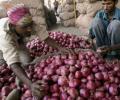
In the retail markets, fresh onion is sold between Rs 10 and Rs 12 a kg. Now, farmers have to sell onion at a loss of Rs 2-3 per kg if transport cost is included.
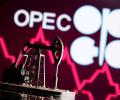
Changes in global oil and gas rates matter more to India's economy than other major economies because the country imports around 87 per cent of its oil, half of its gas in the form of LNG, and over 60 per cent of its LPG.

'The question is, how soon we can expect to re-attain the pre-lockdown levels of output and income.'
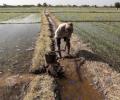
Bharat Krishak Samaj demanded that the Pradhan Mantri Fasal Bima Yojana should be replaced with a new crop insurance and compensation scheme.

The department has proposed to pool prices of imported and domestically produced natural gas.

'On the tax front, most of the Budget proposals are sensible'.
